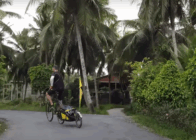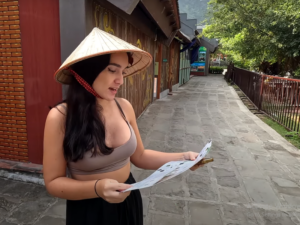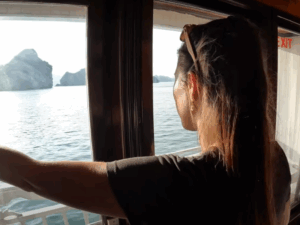

What truly defines an authentic Vietnam adventure in an era dominated by mass tourism, predictable itineraries, and crowded resort corridors? It is the raw, unscripted friction between pristine tropical geography and ancient local traditions. Extending over 1,600 kilometers across the eastern edge of the Indochinese Peninsula, Vietnam holds one of Asia’s most ecologically diverse and culturally complex wilderness corridors. Beyond its iconic coastal cities lies a world of vertical limestone massifs, emerald highland lakes, ancient primeval forests, and resilient upland ethnic communities that have maintained their traditional way of life for generations.
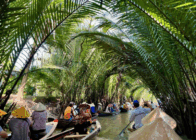
However, executing an expedition-grade journey requires a operational approach far removed from standard tourism. Seeking an authentic Vietnam adventure demands more than simply booking a bus ticket or checking off popular monuments. It requires deep geographical navigation: traversing remote mountain passes where weather shifts in minutes, gliding across quiet river basins in hand-carved wooden watercraft, sharing home-cooked meals around open hearths in traditional stilt houses, and trekking along unpaved footpaths that connect isolated rural hamlets. Achieving this level of discovery without sacrificing ground safety requires meticulous planning, local community partnerships, and verified logistics.
Whether your vision of an off-the-beaten-path journey involves multi-day alpine ridge trekking, exploring deep karst river basins, cycling along pastoral borderlands, or immersing yourself in highland ethnic heritage, this comprehensive 3,000+ word masterplan redefines what an authentic Vietnam adventure represents. Below is your complete guide to deep cultural discovery, remote wilderness corridors, ethical community engagement, and practical field execution across Vietnam.
Before setting off on an immersive wilderness expedition across Southeast Asia, securing absolute financial protection, verified government licensing, and 24/7 crisis support is essential. Learn how to protect your travel investment by reading our comprehensive guide on the best vietnam tour operators to see how top-rated local outfitters compare in safety compliance, private fleet logistics, and custom expedition management.
Section 1: The Core Philosophy of True Discovery
To understand why an authentic Vietnam adventure captures the imagination of seasoned global travelers, one must examine the philosophical shift from passive sightseeing to active wilderness immersion.
+-----------------------------------------------------------------------------------+
|               THE FOUR PILLARS OF AN AUTHENTIC VIETNAM ADVENTURE                  |
+-----------------------------------------------------------------------------------+
| 1. Cultural Depth        ➔ Direct, respectful engagement with local native masters |
| 2. Geographical Immersion ➔ Off-grid navigation of uncommercialized river basins  |
| 3. Ecological Integrity   ➔ Minimal impact travel adhering to Leave-No-Trace principles|
| 4. Operational Safety     ➔ Professional fleet support & wilderness first-aid backing |
+-----------------------------------------------------------------------------------+
1. Stripping Away Commercial Tourism Barriers
Standard tour packages often wrap travelers in a comfortable bubble—moving from international hotel lobbies to crowded tourist sights in large air-conditioned coaches. An authentic Vietnam adventure intentionally breaks through that commercial barrier. It invites travelers to experience real life: sharing green tea with a village elder on a wooden porch, navigating mountain passes shrouded in morning mist, and discovering quiet rural landscapes where traditional agricultural practices have remained unchanged for centuries.
2. Living Heritage over Static Museum Display
Vietnam’s rich cultural identity rests in its 54 officially recognized ethnic groups, each maintaining distinct linguistic dialects, architectural traditions, textile arts, and spiritual customs. On an authentic Vietnam adventure, you do not view these cultures through museum glass; you walk alongside local farmers through their terraced rice fields, witness age-old bamboo waterwheel engineering, and stay as a guest in family-operated wooden stilt houses.
3. Spatial Slowness vs. Superficial Speed
Modern travel culture often emphasizes speed—attempting to cover as many cities as possible within a single week. Conversely, an authentic Vietnam adventure prioritizes slowness and geographical depth. Spending three uninterrupted days exploring a single mountain valley or karst lake system allows travelers to observe subtle wildlife patterns, understand local ecology, and build meaningful connections with resident communities that fast-paced trips completely miss.
Section 2: Deep Exploration of 4 Remote Expeditions
To help you design an extraordinary off-the-beaten-path itinerary, we have detailed four remote regional corridors where an authentic Vietnam adventure unfolds far away from tourist crowds:
[Corridor 1: Northern Lakes & Karst Basins] ➔ [Corridor 2: Central Upland Valleys]
    (Ba Be Lakes & Pac Bo Borderlands)            (Pu Luong & Mai Chau Basins)
                         │                                    │
                         ▼                                    ▼
[Corridor 3: Eastern Frontier Waterways]  ➔ [Corridor 4: Central Highland Plateaus]
    (Ban Gioc & Quay Son Valley)                  (Kontum & Plei Kan Wilderness)
Corridor 1: Northern Lakes & Karst Basins (Ba Be National Park & Pac Bo)
Located in Bac Kan and Cao Bang provinces in the far northeast, this remote limestone wilderness centers around Vietnam’s largest natural mountain lake and historical river valleys.
1. Ba Be Lake Navigation & Primary Rainforests
Topographic Profile: A massive freshwater lake perched 150 meters above sea level, enclosed by vertical limestone cliffs, dense primary rainforest, and cascading river systems.
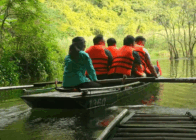
Executing an Authentic Vietnam Adventure Here: Board traditional hand-carved wooden dugout boats (độc mộc) or silent eco-kayaks operated by local Tày boatmen to explore pristine waters. Navigate through Puong Cave—a massive 300-meter limestone tunnel carved straight through a mountain peak by the Nang River—before trekking through primary jungle to secret waterfalls like Dau Dang. Spend evenings staying in traditional wooden stilt-house homestays along Pac Ngoi or Bo Lu villages, dining on wild lake fish and bamboo shoots.
2. Pac Bo Borderland Valley & Historical Trails
Topographic Profile: A quiet, turquoise river basin surrounded by steep limestone peaks along the international border with China.
Executing an Authentic Vietnam Adventure Here: Trek along the crystal-clear waters of the Lenin Stream, explore historical mountain caverns like Karl Marx Cave, and interact with ethnic Nung farming families who cultivate corn and rice across the valley floor.
Corridor 2: Central Upland Valleys (Pu Luong & Mai Chau Basins)
Positioned within Thanh Hoa and Hoa Binh provinces, this agricultural haven offers towering mountain backdrops, sweeping terraced fields, and peaceful village life without mass tourist crowding.
1. Pu Luong Nature Reserve Trekking
Topographic Profile: Parallel limestone mountain ridges enclosing steep valleys, tropical rainforests, and hand-carved agricultural rice terraces.
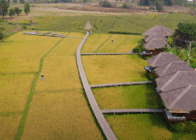
Executing an Authentic Vietnam Adventure Here: Embark on multi-day village-to-village treks crossing bamboo suspension bridges and narrow earthen dikes. Witness massive hand-engineered wooden water wheels (guồng nước) built by local White Thai communities to lift river water into elevated agricultural fields. Sleep in family-operated bamboo stilt houses overlooking endless green valleys, enjoying traditional hospitality and herbal foot baths after long days on the trail.
2. Mai Chau Valley Rural Cycling
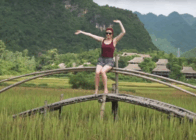
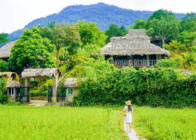
Topographic Profile: A wide, flat emerald basin surrounded by sheer karst mountains, dotted with quiet wooden stilt hamlets.
Executing an Authentic Vietnam Adventure Here: Rent mountain bicycles to explore quiet dirt trails connecting Lac, Poom Coong, and Cha Long villages. Observe local women working traditional hand-looms to weave intricate brocade textiles, and sample local dishes like bamboo-cooked sticky rice (cơm lam).

Corridor 3: Eastern Frontier Waterways (Ban Gioc & Quay Son Valley)
Positioned along the northeastern frontier in Cao Bang province, this region features some of Asia’s most spectacular waterfalls and karst river landscapes.
1. Quay Son River Basin & Border Trails
Topographic Profile: A serene river winding through patchwork agricultural fields, framed by steep limestone pinnacles along the border.
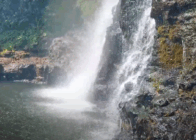
Executing an Authentic Vietnam Adventure Here: Board small bamboo rafts to paddle right up to the misty spray of Ban Gioc Waterfall—one of the largest transnational waterfalls in the world. Cycle along quiet country roads flanked by stone-walled farmsteads, and explore ancient limestone caverns such as Nguom Ngao Cave, famous for its massive subterranean chambers and unique rock formations.
Corridor 4: Central Highland Plateaus (Kontum & Plei Kan Wilderness)
Moving south into the rolling basalt plateaus of Vietnam’s Central Highlands reveals an entirely different ecological and cultural realm.
1. Kontum Tribal Lands & Highland Forests
Topographic Profile: Rich red basalt plateaus, pine-forested hills, rushing river networks, and historic indigenous tribal territories.
Executing an Authentic Vietnam Adventure Here: Explore traditional Bahnar villages centered around soaring wooden communal houses (Nhà Rông). Learn about UNESCO-recognized highland gong culture, trek through quiet pine forests, and cross the Dak Bla River in traditional wooden canoes accompanied by local indigenous guides.
Section 3: Detailed Expedition Comparison Matrix
To help active travelers choose the ideal region for their authentic Vietnam adventure, this decision matrix compares terrain profiles, technical requirements, physical effort, and ideal operating windows across all four corridors:
| Expedition Corridor | Geographic Location | Key Environmental Feature | Technical Effort Level | Primary Transit / Activity | Optimal Operating Window |
| Ba Be & Pac Bo Basin | Bac Kan / Cao Bang | Limestone lake & primary rainforest | Moderate (Kayaking & trail hiking) | Wooden dugouts, kayaks, footpaths | October to April |
| Pu Luong Reserve | Thanh Hoa Province | Terraced valleys & karst ridges | Moderate to High (Multi-day trekking) | Trekking on foot, mountain bikes | September to November / March to May |
| Quay Son Frontier | Cao Bang Borderland | Transnational waterfalls & river valleys | Easy to Moderate (Cycling & paddling) | Bamboo rafts, bicycles, 4×4 SUVs | September to December |
| Central Highlands | Kontum / Plei Kan | Basalt plateaus, pine forests & rivers | Moderate (Forest walks & river canoes) | 4×4 SUVs, wooden canoes, walking | November to March |
Section 4: Responsible Ecotourism & Community Integration
An authentic Vietnam adventure relies on building respectful, beneficial relationships with local communities and ecosystems. Practicing responsible travel ensures that your presence actively supports local livelihoods while preserving cultural heritage and natural habitats.
                  [ETHICAL COMMUNITY ENGAGEMENT FRAMEWORK]
                                     │
      ┌──────────────────────────────┼──────────────────────────────┐
      ▼                              ▼                              ▼
[Direct Economic Impact]     [Cultural Integrity]         [Environmental Stewardship]
(Stay in local homestays &   (Respect village customs &    (Follow Leave-No-Trace rules &
 pay fair guide wages)        sacred communal spaces)       eliminate single-use plastics)
1. Supporting Community-Based Tourism (CBT) Cooperatives
When planning an authentic Vietnam adventure, prioritize accommodations and excursions managed directly by village cooperatives.
Direct Economic Benefits: Staying in local stilt-house homestays ensures that room fees, meal costs, and guide wages flow directly to host families rather than distant corporations.
Authentic Culinary Exchange: Enjoy fresh, home-cooked meals prepared over open wood fires using organic vegetables harvested straight from family gardens and fish caught from local rivers.
2. Cultural Etiquette in Native Upland Villages
Entering traditional ethnic minority hamlets requires mindfulness and respect for local customs:
Respecting Sacred Spaces: Many villages maintain sacred forests, ancestral shrines, or spirit gates (Cúng bản). Always consult your local guide before entering restricted ceremonial areas.
Ethical Photography Practices: Always ask for verbal permission before photographing village elders, artisans, or private homes. Respect a polite refusal without hesitation.
Responsible Gift-Giving: Avoid giving candy or money directly to children in rural villages, as this can encourage begging. Instead, work with local school leaders or tour outfitters to donate educational materials to village schools.

Section 5: Field Logistics, Gear Standards & Safety Protocols
Executing an authentic Vietnam adventure in remote, uncommercialized regions requires proper physical conditioning, technical gear selection, and robust safety protocols.
1. Essential Technical Field Gear
Standard rolling suitcases and casual urban shoes are completely unsuited for unpaved mountain trails and rural river crossings. Equip yourself with specialized gear:
Footwear: Lugged, waterproof hiking boots with ankle support and deep tread patterns for navigating muddy clay paths and slick limestone rocks.
Apparel: Breathable, moisture-wicking synthetic layers, long-sleeved trekking shirts to protect against sun and foliage, and lightweight waterproof shell jackets.
Field Accessories: A durable 30L daypack with a rain cover, high-capacity portable power banks (electricity can be intermittent in remote homestays), personal water purification bottles, and eco-friendly insect repellent.
2. Private Fleet Support and Backcountry Navigation
Navigating remote mountain provinces like Bac Kan, Cao Bang, or Kontum requires experienced local drivers and sturdy vehicles.
Chauffeured 4×4 SUVs and Vans: High-value itineraries coordinate private transfers with local drivers experienced in managing mountain switchbacks, unpaved terrain, and changing weather conditions.
24/7 Backcountry Communication: Ensure your outfitter maintains active satellite or cellular radio links, providing complete safety backing when exploring regions beyond standard mobile phone coverage.
Section 6: Frequently Asked Questions (FAQ)
Q1: What makes an authentic Vietnam adventure different from a standard tour?
A: Standard tours focus on major urban landmarks, large hotel chains, and crowded tourist attractions. An authentic Vietnam adventure takes you off the beaten path into remote rural valleys, ethnic minority villages, pristine national parks, and quiet river systems, emphasizing deep cultural connection and active exploration.
Q2: Are village homestays suitable and comfortable for international travelers?
A: Yes! While rustic, community homestays in regions like Ba Be Lake or Pu Luong offer clean sleeping mats with fresh mosquito nets, warm blankets, well-maintained bathroom facilities, hot showers, and delicious home-cooked meals prepared by host families.
Q3: How do I handle permits for restricted border areas on an authentic Vietnam adventure?
A: Certain frontier zones (such as areas near Ban Gioc Waterfall or remote border passes) require special travel permits issued by provincial security authorities. Booking your authentic Vietnam adventure through a licensed local operator like Saola Tours ensures all required government permits are arranged seamlessly ahead of time.
Section 7: Craft Your Expedition with Saola Tours
Executing an authentic Vietnam adventure with complete peace of mind requires deep local roots, verified safety standards, transparent pricing, and full state licensing. At Saola Tours, we specialize in building 100% tailor-made private wilderness itineraries—complete with certified ethnic-minority guides, private chauffeured vehicles, handpicked eco-lodges, and 24/7 ground support.
➡️ Ready to step beyond the tourist trails and launch your ultimate Vietnam adventure?
Contact our travel specialists at Saola Tours today to receive your personalized itinerary proposal and local advice!