The best Vietnam visa guide begins with good news: entering Vietnam has never been easier. Citizens of more than thirty countries can arrive without a visa, and everyone else can apply online for an e-visa that is valid for up to 90 days and usually approved within a few working days. The bad news is that the rules differ by passport, they change often, and a wrong assumption can leave you stuck at the airport or paying a fake website.
This Vietnam visa guide walks you through six steps in the order you should do them: check your passport, check whether you are visa-exempt, choose between an exemption and an e-visa, apply on the official portal, prepare for arrival and stay within the rules. It also covers the most common mistakes and answers the questions travellers ask most. Visa rules change, so use this as a guide, not as legal advice, and confirm every detail on official sources before you book anything non-refundable.
It supports our main guide to Vietnam travel tips, which covers money, safety and etiquette, and it pairs with our guide to Vietnam tour packages if you are still choosing a route. A reliable Vietnam visa guide should save you time, and this one is built to do that.
Vietnam Visa Guide at a Glance: Which Route Is Yours?
Start with this table in the Vietnam visa guide, because your passport decides your route.
| Your passport | Typical route | Maximum stay | Cost |
|---|---|---|---|
| United Kingdom, Germany, France, Italy, Spain, Japan, South Korea, Russia, Denmark, Sweden, Norway or Finland | Visa-free entry | 45 days | Free |
| Belgium, Bulgaria, Croatia, Czech Republic, Hungary, Luxembourg, Netherlands, Poland, Romania, Slovakia, Slovenia or Switzerland | Visa-free entry | 45 days | Free |
| Chile or Panama | Visa-free entry | 90 days | Free |
| ASEAN and some other countries | Visa-free entry under bilateral agreements | Often 14 to 30 days | Free |
| The USA, Canada, Australia and most other countries | E-visa | Up to 90 days | About US$25 single entry or US$50 multiple entry |
The 45-day exemptions for the first group run to 14 March 2028 under Resolution 44/NQ-CP, and the exemptions for the second group run to 14 August 2028 under Resolution 229/NQ-CP. British National Overseas passports are not covered by the UK exemption. Lists change, so check the Vietnam Ministry of Foreign Affairs visa exemption list for your passport.

Vietnam Visa Guide Step 1: Check Your Passport
The first step in any Vietnam visa guide is the passport itself, because problems here cannot be fixed at the airport.
- It should be valid for at least six months after your arrival date.
- It should have at least two blank pages and no damage.
- You must enter and leave on the same passport.
- The name and number on your visa or e-visa must match it exactly.
- Carry the same passport on domestic flights, because airlines ask for the one you used to enter.
If your passport expires within six months of your trip, renew it first. This is the most avoidable problem in the whole Vietnam visa guide.
Vietnam Visa Guide Step 2: Check Whether You Are Visa-Exempt
The second step is to find out whether you need to apply for anything at all.
Vietnam grants visa-free entry in three ways. Unilateral exemptions, such as the 45-day stay for the countries in the table above, are decisions by the Vietnamese government that it extends from time to time. Bilateral agreements, such as those with ASEAN members, give stays of 14 to 30 days or more. Special rules also apply on islands, because visitors who arrive directly in Phu Quoc from abroad can stay on the island for up to 30 days without a visa, though going on to the mainland requires the right entry permission.
If your passport appears in a visa-free group, you do not need to apply. Immigration stamps your passport on arrival, so check that the exit date shows the full period you are entitled to. If your country is not on the list, you need an e-visa, which the next step explains. Our Vietnam travel tips guide covers what else to prepare.
Vietnam Visa Guide Step 3: Choose Between an Exemption and an E-visa
Some travellers can choose, and the third step in this Vietnam visa guide helps you decide.
| Factor | Visa exemption | E-visa |
|---|---|---|
| Cost | Free | About US$25 single entry, US$50 multiple entry |
| Maximum stay | 45 days for most exempt Western passports | Up to 90 days |
| Application | None, you simply arrive | Online, a few working days before travel |
| Entry points | Any open international gate | Only the ports you choose on the form |
| Best for | Trips under 45 days | Longer stays, or if your passport is not exempt |
If you plan to stay longer than 45 days, apply for an e-visa even if your passport is exempt. If you will be in Vietnam for fewer days, the free exemption is simplest. Some travellers use an approval letter to get a visa on arrival, but that route involves an agent and a stamping fee and is rarely better than the e-visa, so most travellers can ignore it.
Vietnam Visa Guide Step 4: Apply for the E-visa on the Official Portal
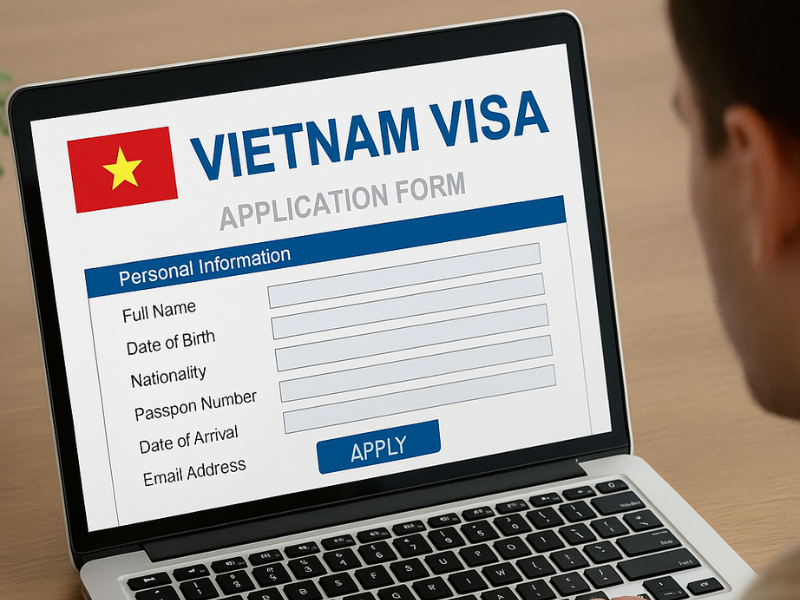
Applying takes about fifteen minutes if you prepare first, and this step of the Vietnam visa guide is the one where scams appear.
- Go to the official government portal, evisa.gov.vn, or the Ministry of Public Security site, and check the address carefully. Other sites charge extra.
- Prepare a clear photo of your passport data page and a recent portrait photo.
- Fill in your personal details, your arrival and departure dates and your entry and exit ports, plus your first night’s address in Vietnam.
- Choose single or multiple entry, and pay the state fee by card, which at the last check was US$25 for single entry and US$50 for multiple entry.
- Note your registration code, and wait for approval, which usually takes three to five working days.
- Check your status with the code, then download and print the approval.
Apply at least one to two weeks before you travel, because delays happen. Check every detail against your passport, since a typo can cause problems at the border. Use the official Vietnam e-visa portal and avoid any website that adds service fees or asks for more than the state fee unless you have chosen a paid agent on purpose. If a Vietnam visa guide recommends a site that is not on a gov.vn domain, treat it as an intermediary.
Vietnam Visa Guide Step 5: Prepare for Arrival
Having the right visa is only part of entry, so the fifth step in this Vietnam visa guide covers the border.
- Carry your printed e-visa approval or your passport with the exemption details.
- Have a hotel address and your onward or return ticket ready, because officers may ask for both.
- Complete the Vietnam digital arrival card if the airport you use encourages it. Since April 2026, the government has encouraged visitors at Ho Chi Minh City’s airport to complete one online, and some sources describe it as mandatory there, so check the current rule.
- A health declaration, which may include proof of vaccinations, can be required, so check with the Vietnamese Embassy.
- If you transfer from an international flight to a domestic flight in Hanoi or Ho Chi Minh City, you must clear immigration first.
- Declare cash above 15 million Vietnamese dong or 5,000 US dollars when you enter or leave.
Make the same checks when you leave Vietnam, and keep your documents together. Our Vietnam eSIM guide and Vietnam packing list help with the rest of your preparation.

Vietnam Visa Guide Step 6: Stay Within the Rules
The last step in this Vietnam visa guide is about the length of your stay.
Count your days from the date of entry, and leave before your permitted stay ends. Overstaying can lead to fines, delays when you try to leave and trouble with future visits, so build in a margin. Extensions are sometimes possible through immigration offices or agents, but they are not guaranteed, so do not rely on one. If you cross a land border to Cambodia or Laos and come back, check whether your e-visa or exemption allows re-entry and which gates it covers. Our guides to Cambodia and Vietnam tours packages and Laos and Vietnam tours explain the practical side of crossing borders.
Also remember that a tourist entry does not allow you to work, so check with an official source before you do anything beyond sightseeing.
Visa Rules for UK, US and Australian Travellers in This Vietnam Visa Guide
The three markets we serve most often have very different needs, so this part of the Vietnam visa guide summarises them.
| Passport | What you need | Where to read more |
|---|---|---|
| British citizen passport | No visa for up to 45 days, valid passport with six months and two blank pages | Our guide to Vietnam tour packages from the UK and the FCDO Vietnam travel advice |
| United States passport | An e-visa for stays up to 90 days | Our guide to Vietnam tour packages from the USA |
| Australian passport | An e-visa for stays up to 90 days | Our guide to Vietnam tour packages from Australia and the Smartraveller Vietnam travel advice |
Canadians and many other nationalities follow the same e-visa route as US and Australian passport holders. Whatever your passport, read the official advice from your own government as well as the Vietnamese portal.
Seven Mistakes This Vietnam Visa Guide Helps You Avoid
Most visa problems are avoidable, so check this list before you book flights.
- Applying on an unofficial site. It costs more and gains nothing.
- Assuming your passport is exempt. Check the current list for your country.
- Travelling with less than six months of validity. You may be refused.
- Typing details that do not match your passport. A small error can cause trouble.
- Choosing the wrong entry port. An e-visa only works at the ports you select.
- Applying too late. Leave at least one to two weeks.
- Overstaying. Fines and delays follow.
Avoid these seven, and the Vietnam visa guide will have done its job.
Vietnam Visa Guide FAQ
Do I need a visa for Vietnam?
That depends on your passport. Citizens of the UK and many European countries can enter free for up to 45 days, while US, Canadian and Australian passport holders need an e-visa.
How long does an e-visa take?
The Vietnam visa guide figure from official portal sources is about three to five working days, but apply at least one to two weeks ahead to be safe.
How much does the e-visa cost?
At the last check, the state fee was US$25 for single entry and US$50 for multiple entry, and the e-visa is valid for up to 90 days. Confirm the fee on the official portal before you pay.
Can I extend my stay in Vietnam?
Sometimes, through immigration offices or agents, but approval is not guaranteed. For stays over 45 days, it is safer to apply for a 90-day e-visa from the start.
Is the digital arrival card mandatory?
Since April 2026 it has been encouraged, and in some cases required, at Ho Chi Minh City’s airport. Read the current Vietnam visa guide advice from the FCDO or the Vietnamese authorities before you fly.
Do I need a visa for Phu Quoc?
Visitors who arrive directly in Phu Quoc from abroad can stay on the island for up to 30 days without a visa. If you plan to visit the mainland, you need the right entry permission for it. See our Phu Quoc travel guide.
Do children need a visa?
Yes, every traveller needs their own passport and, where required, their own visa or e-visa.
Is a visa guide different if I visit Cambodia and Laos too?
Yes. Each country has its own entry rules, and e-visas are limited to the ports you choose. Check each country separately.

Put This Vietnam Visa Guide Into Practice
A good Vietnam visa guide comes down to six habits: check your passport, check whether you are exempt, choose the right route, apply on the official portal, prepare for the border and stay within the rules.
For more advice before you fly, read our Vietnam travel tips guide and our Vietnam travel insurance guide, then see how a local team plans a trip in our Vietnam tour packages guide. If you prefer a route designed around you, see our Vietnam private tour page and our 14 days in Vietnam itinerary.
Tell us when you travel and what passport you hold, and Sao La Vietnam Tours will help you plan the right route and timing. We are a Hanoi-based travel consultancy that creates private journeys across Vietnam, so contact us today and let this Vietnam visa guide become a real plan.