1. The Quiet Echo of a Thousand Years
Hanoi in April 2026 is a city of high-velocity ambition, where glass-and-steel towers reach for the clouds and the hum of the Metro Line dominates the urban soundscape. Yet, behind the ancient stone walls on Quoc Tu Giam Street lies a pocket of preserved time. The Temple of Literature (Văn Miếu – Quốc Tử Giám) is not merely a park of pavilions and ponds; it is the visual and spiritual record of Vietnam’s intellectual sovereignty.
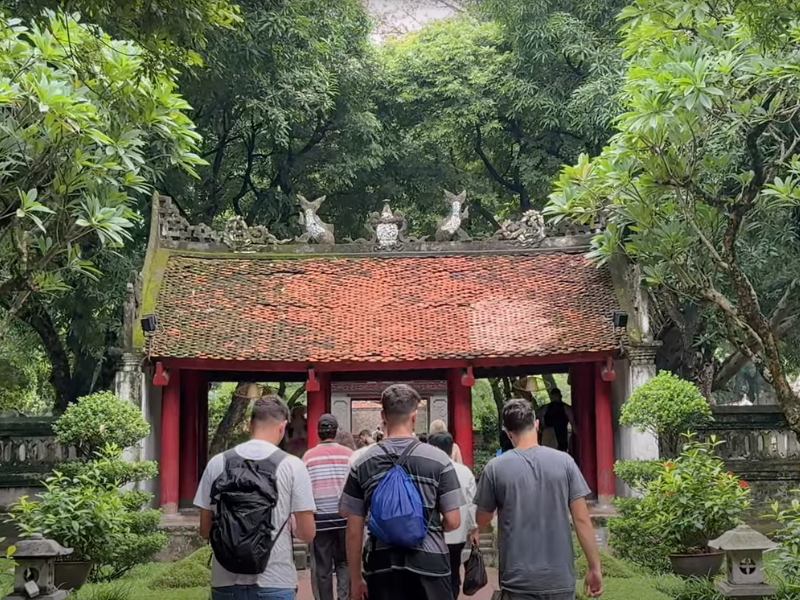
For the elite traveler, the Temple is an exercise in sensory recalibration. The moment you cross the threshold of the Great Middle Gate, the roar of the motorbikes is replaced by the rustle of century-old banyan trees. At Sao La Tours, we approach this site as the “Academy of Sages”—a place where the DNA of Vietnamese governance, social ethics, and leadership was coded long before the modern era. In this first part, we explore the sacred foundations of the site and the rigorous “Mandarin” culture that defined the nation’s history.
2. The 1070 Mandate: A Foundation of Sovereignty
The founding of the Temple in 1070 by Emperor Ly Thanh Tong was a strategic masterstroke. By dedicating this sanctuary to Confucius and the great scholars, the Ly Dynasty was declaring that Vietnam was not just a military power, but a Civilizational Power.
The Imperial Academy: Six years later, in 1076, the Quốc Tử Giám was established behind the temple as the country’s first national university. This was the laboratory where the nation’s elite—the Mandarins—were forged.
The Meritocratic Shift: Long before modern corporate meritocracy, the Temple represented a revolutionary idea: that power should be granted to those with intellect and virtue, regardless of their birth. This “Scholarly Ascent” became the bedrock of Vietnamese social structure, a legacy that remains palpable in the city’s high esteem for education in 2026.
3. The Architecture of Discipline: The Five Courtyards
The layout of the Temple is a physical manifestation of a scholar’s journey toward enlightenment. Each of the five courtyards represents a progressive stage of discipline and focus.
The Geography of Wisdom
The First & Second Courtyards: These are spaces of preparation. The lush gardens and ancient trees serve to cleanse the mind of worldly distractions. In 2026, we utilize these spaces for our “Silent Briefings,” allowing guests to absorb the atmosphere before diving into the historical data.
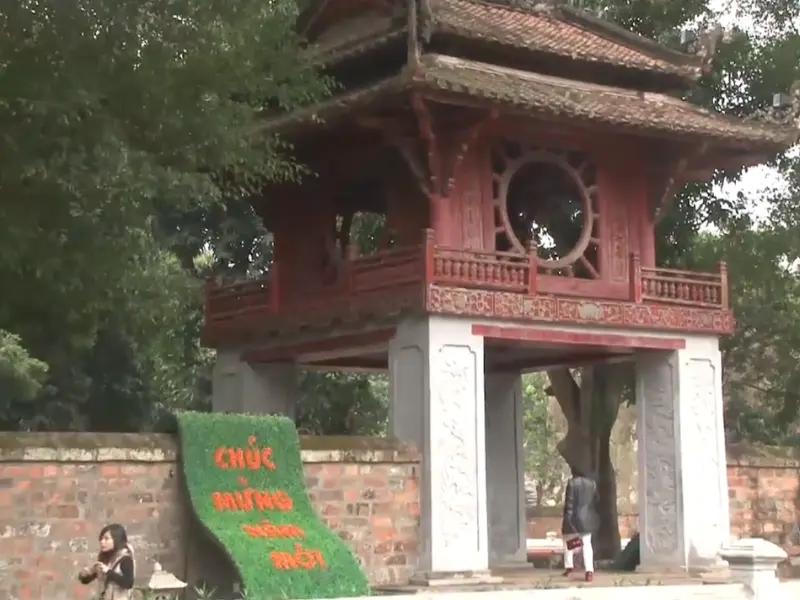
The Khue Van Cac (Pavilion of the Constellation of Literature): This iconic red wooden structure, now the symbol of Hanoi, was built in 1805. It represents the “Starlight of Literature.” Its circular windows reflect the sun’s rays, symbolizing the light of knowledge shining upon the earth.
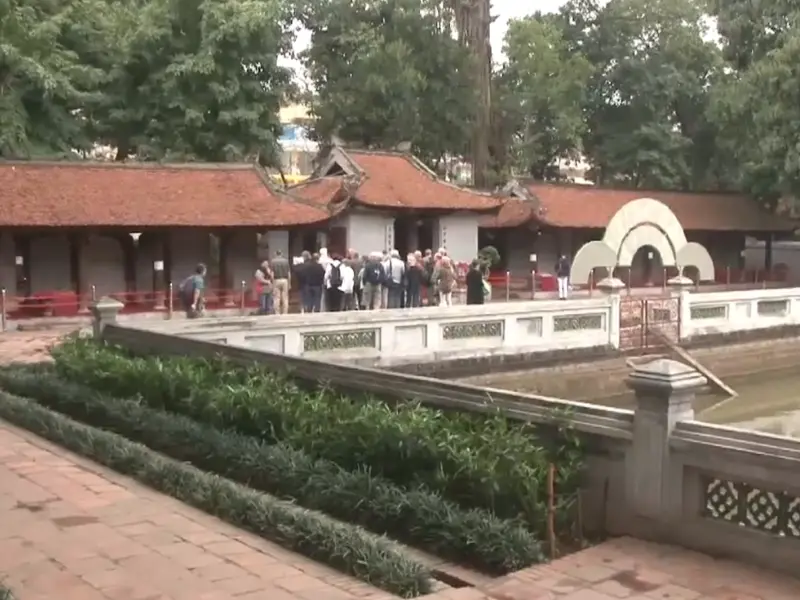
The Third Courtyard (The Well of Heavenly Clarity): Here, the architecture opens up. The square pool acts as a mirror, reflecting the sky and reminding the scholar that their knowledge must be as clear and vast as the heavens.
4. The Stelae of Doctors: Stone Records of Human Potential
The heart of the Temple’s cultural value lies in the 82 stone stelae, perched on the backs of stone tortoises. These are not just monuments; they are the “Honor Roll” of centuries.
The 2026 Preservation: Following the major conservation efforts leading into this year, the stelae are now protected by advanced climate-controlled canopies and UV-filtered glass enclosures that are nearly invisible to the naked eye. These prevent the acid rain and humidity of Hanoi from further eroding the 1,307 names of those who passed the grueling Royal Examinations between 1442 and 1779.
The Tortoise Symbolism: In Vietnamese culture, the tortoise represents longevity and perseverance. Touching the head of the tortoise was once a tradition for students seeking luck; today, in 2026, we honor the “No-Touch” policy to preserve the stone, instead utilizing AR (Augmented Reality) Scanners that allow our guests to “touch” the digital twin of the stelae and translate the ancient Han-Nom inscriptions in real-time.
5. Comparison: The 1076 Scholar vs. The 2026 Professional
| Aspect | The Imperial Mandarin (11th-18th Century) | The Modern Executive (2026) |
| Core Value | Confucian Ethics & Sincerity | Data Integrity & Global Strategy |
| Selection | Three-Year Royal Examinations | AI-Vetted Competencies & EQ |
| Philosophy | “Learn to be a Sage” | “Learn to be Agile” |
| Symbolism | The Brush and the Inkstone | The Neural Interface & Digital Ink |
| Legacy | Names Carved in Stone | Digital Footprints & IP |
6. The Mandarin Mindset: Leadership Through Ethics
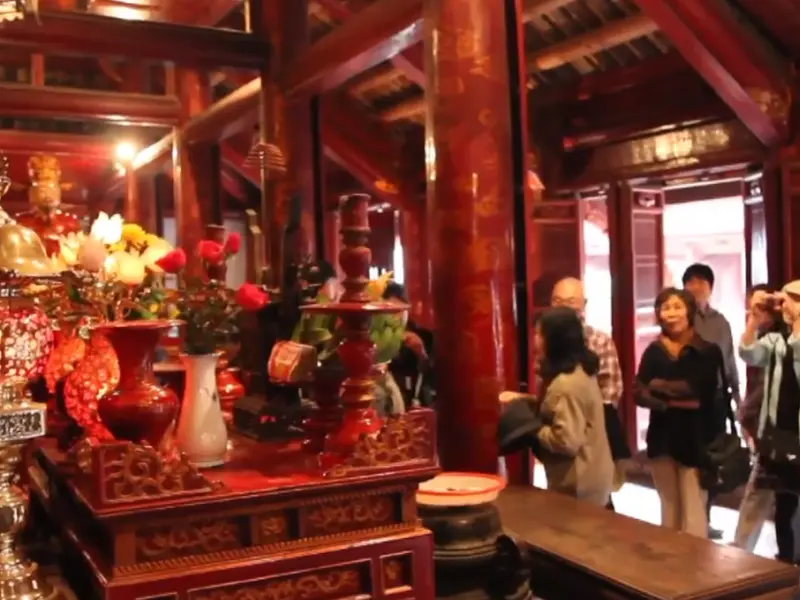
At the far end of the complex stands the Thai Hoc House, where the statues of the three Great Emperors (Ly Thanh Tong, Ly Nhan Tong, and Le Thanh Tong) and the venerable teacher Chu Van An reside.
Chu Van An – The Moral Compass: He is remembered not for his political power, but for his integrity. When he saw corruption in the court, he submitted a petition to behead seven corrupt officials. When it was rejected, he resigned and returned to teaching.
The 2026 Relevance: For our executive guests, the story of Chu Van An is a profound lesson in Corporate Governance and Ethics. In the high-stakes business environment of 2026, the Temple serves as a reminder that prestige without virtue is a hollow spire.
7. Preliminary Insights: The Gateway to the Soul
We have established the “Bones” of the Temple of Literature—its royal ancestry, its architectural progression through the five courtyards, and the weight of history held within the Stelae of Doctors. We understand that this is not a temple of gods, but a temple of Human Achievement.
But how does this ancient seat of learning interact with the modern world? Beyond the stone gates, a new kind of energy is brewing. In the next part, we will explore the “Digital Renaissance” of the Temple, the mesmerizing Night Tours, and the aesthetic details that make it a masterpiece of wood and light.
8. Architectural Alchemy: The Geometry of Wisdom
The Temple of Literature is a masterclass in Feng Shui and Confucian Symbology. Every wooden beam and stone pillar was placed to create a “Sacred Order” that reflects the harmony between Heaven (Thiên), Earth (Địa), and Humanity (Nhân).
The Yin-Yang Balance
In 2026, preservationists have highlighted the Temple’s ability to remain cool and serene despite the rising temperatures of Hanoi’s urban heat island.
The Breathing Wood: The structure relies heavily on Ironwood (Gỗ Lim). In the early 2020s, these timbers underwent a non-invasive Ultrasonic Structural Audit to identify internal decay. By 2026, the wood has been treated with organic, fire-retardant resins that preserve its deep, dark luster while allowing the material to “breathe” with the humidity.
The Liquid Mirror: The Well of Heavenly Clarity (Thiên Quang Tỉnh) is not just ornamental. It serves as an acoustic dampener and a natural cooling agent. The square shape of the well (representing the Earth) juxtaposed against the circular windows of the Khue Van Cac (representing the Sun) creates a geometric dialogue that was meant to subconsciously stabilize the mind of the scholar.
9. The 2026 Night Tour: A 3D Mapping Renaissance
The most significant shift in the Temple’s modern history is the introduction of the “Quintessence of Education” Night Tour. By April 2026, this has become the gold standard for heritage storytelling in Southeast Asia.
The Light Narrative
3D Projection Mapping: Every evening at 7:30 PM, the Thai Hoc courtyard is transformed. Utilizing high-lumen 4K laser projectors hidden within the eaves, the history of the Stelae of Doctors is projected onto the architectural surfaces. The stone tortoises appear to “wake up,” and the names of the ancient scholars are illuminated in gold light, flowing across the courtyard like a river of knowledge.
Holographic Sages: Through the use of Transparent LED screens and holographic arrays, visitors can witness a “Digital Reconstruction” of a royal examination. You see the scholars in their traditional robes, the intensity of their focus, and the moment of their triumph, all rendered in life-sized detail.
The Acoustic Layer: The tour is paired with a Spatial Audio Soundtrack. Using directional speakers, the sound of traditional Ca Trù music and the scratching of brushes on parchment follows you as you walk, creating a 360-degree sensory immersion.
10. The Art of the Inscription: Deciphering Han-Nom in the Digital Age
The 82 Stelae of Doctors are often described as “Stone Genealogies.” In 2026, the way we interact with these UNESCO-listed artifacts has been completely transformed by technology.
AR Translation Interactivity: For Sao La Tours guests, we provide proprietary AR Visors. As you look at a particular stela, the visor highlights the Han-Nom characters (the ancient Vietnamese logographic script) and provides an instantaneous, high-fidelity translation into English or modern Vietnamese.
The “Virtue” Analysis: These inscriptions do not just list names; they are philosophical essays on the nature of government. One famous inscription from 1442 states: “Virtuous and talented men are the sap of life for the state.” In 2026, this remains the primary case study we use when discussing Human Capital Strategy with our corporate clients.
11. Comparison: The Sensory Audit (Day vs. Night)
| Sensory Element | Daytime: The Scholarly Walk | Night: The Digital Odyssey |
| Primary Visual | Deep Greens, Weathered Grey Stone | Gold & Azure Light Projections |
| Soundscape | Rustling Leaves, Distant City Hum | Orchestrated Spatial Audio & Ca Trù |
| Atmosphere | Meditative, Historical, Serious | Magical, Immersive, Dynamic |
| Key Activity | Studying Inscriptions & Architecture | 3D-Mapping Show (Thai Hoc House) |
| Guest Vibe | The Researcher / The Historian | The Visionary / The Explorer |
12. The Floral Architecture: Gardens as Philosophy
The gardens of Van Mieu are not random; they are a “Living Library.”
The Frangipani & The Banyan: Many of the trees in the inner courtyards are over 100 years old. In 2026, these trees are managed via IoT Soil Sensors that monitor hydration and nutrient levels, ensuring that the “Lungs of the Temple” remain vibrant.
Lotus & Scholarly Purity: The presence of lotus flowers in the outer ponds serves as a metaphor for the scholar: rising from the mud (humble beginnings) to bloom in the sun (academic achievement). For our guests, we arrange Private Tea Ceremonies in the peripheral gardens, utilizing lotus-scented tea—a practice that has been a staple of the Hanoi intelligentsia for centuries.
13. Preliminary Insights: The Synthesis of Past and Future
We have explored the Alchemy of Van Mieu—the transition from the rigid timber and stone of the 11th century to the laser-mapped, digitally translated experience of 2026. The Temple has proven that heritage is not a static object to be guarded, but a living narrative that can be enhanced by the very technology it helped inspire.
However, the Temple’s influence does not stop at its gates. It is the center of a thriving “Intellectual Precinct” in Hanoi. In our final chapter, we will step out into the surrounding neighborhood to explore the modern calligraphy movement, the hidden bookstores, and the “Success Toolkit” for the contemporary visitor.
14. The Scholar’s Lifestyle: Beyond the Stone Gates
In April 2026, the Temple of Literature is the center of a thriving cultural district that bridges the gap between ancient philosophy and modern creativity. The streets surrounding the temple—Van Mieu, Quoc Tu Giam, and Nguyen Thai Hoc—have become the “Intellectual Quarter” of the capital.
The Calligraphy Quarter: The Art of “Xin Chữ”
The ritual of Xin Chữ (Requesting Letters) is the most living expression of the Temple’s legacy.
The 2026 Master Calligraphers: On the sidewalks of the “Calligraphy Street,” masters of the art don their traditional black robes. However, in 2026, the art has evolved. While many still use the traditional brush and inkstone, a new generation of artists is blending Han-Nom characters with modern graffiti and graphic design, creating a “New Scholar” aesthetic that appeals to the city’s tech-savvy youth.
The Ritual of Aspiration: For our Sao La Tours guests, this is more than a souvenir. It is a strategic exercise. We facilitate private sessions where guests discuss their personal or corporate visions with a master calligrapher, who then translates those values into a single, powerful character—representing “Success,” “Wisdom,” or “Resilience”—to be displayed in their home or office.
15. The 2026 Success Toolkit: Navigating the Intellectual Heart
To experience the Temple of Literature with the efficiency and depth required of a modern executive, we provide the following Strategic Framework:
1. The “Dual-Layer” Timing Strategy
The Morning Reflection (07:30 – 09:00): Arrive early for the “Daytime: Scholarly Walk” analyzed in Part 2. The air is fresh, and the shadows of the Khue Van Cac are longest. This is the time for photography and quiet contemplation of the Stelae of Doctors.
The Night Odyssey (19:30 – 21:00): Return for the “Quintessence of Education” 3D-mapping show. By 2026, we recommend booking our “Sovereign Access” package, which includes a private guided walkthrough of the illuminated courtyards before the main show begins.
2. Logistics and Connectivity
The Metro-Link: The Temple is now seamlessly connected via the Hanoi Metro network. In 2026, utilizing the Metro to reach the Van Mieu station is the most “Agile” way to travel, avoiding the Old Quarter’s congestion and allowing for a transition from high-tech transit to high-culture heritage in minutes.
Dress Code & Etiquette: While the atmosphere is academic, the site is sacred. Modest attire—covering shoulders and knees—is mandatory. In 2026, we recommend “Hanoi Linen”—a local sustainable fabric that remains crisp and elegant in the April humidity.
3. The Digital Companion
The “Sao La” AR Visor: As mentioned in Part 2, ensure your AR device is fully synced. In 2026, our proprietary software now includes “Deep-Dive Biographies,” allowing you to see the lineages and life stories of the specific Doctors whose names are carved on the stones as you pass them.
16. 2026 Temple FAQ: Expert Insights
Q1: Is it still possible to see students celebrating graduation?
A: Yes. April and May remain the peak months for “Kỷ Yếu” (Graduation Photography). You will see thousands of students in vibrant Ao Dais and academic robes. While colorful, it can be crowded; our guides help you navigate “Priority Corridors” to ensure your experience remains serene.
Q2: How has the 2026 “Smart-City” initiative changed the Temple?
A: The entire precinct is now a “Quiet Zone.” Noise-canceling barriers and traffic-calming measures around the square have reduced ambient decibels by 40% compared to 2023, making the “Well of Heavenly Clarity” truly silent for the first time in decades.
Q3: Can we participate in a traditional tea ceremony?
A: Absolutely. We arrange private ceremonies in the Thai Hoc House gardens. In 2026, these sessions focus on “Mindful Leadership,” using ancient brewing techniques to foster focus and clarity.
17. Comparison: The 2026 Intellectual Itinerary
| Time | Phase | Activity | Strategic Value |
| 08:00 | The Ascent | Walking the 5 Courtyards | Mental Reset & Focus |
| 10:00 | The Legacy | AR-Analysis of the Stelae | Understanding Meritocracy |
| 11:30 | The Ritual | Private Calligraphy Session | Visualizing Personal Vision |
| 19:30 | The Immersion | 3D-Mapping Night Show | Cultural Synthesis & Tech-Heritage |
| 21:00 | The Reflection | Late-night Tea in the Precinct | Synthesizing the Day’s Lessons |
18. Conclusion: The Moral Compass of the 21st Century
The Temple of Literature in April 2026 is far more than a historical relic; it is Vietnam’s “Intellectual North Star.” We have journeyed from the Sacred Bedrock of its 1070 mandate (Part 1), through the Architectural Alchemy of its 3D-mapped courtyards (Part 2), and finally into the Living Lifestyle of the modern scholar (Part 3).
In an era defined by artificial intelligence and rapid globalization, the Temple stands as a reminder that the most enduring “Operating System” is one built on Ethics, Merit, and Perpetual Learning. It teaches us that to lead effectively in the future, one must be firmly anchored in the wisdom of the past. At Sao La Tours, we don’t just show you the stone; we help you decode the soul.
Master Your Intellectual Odyssey
Hanoi is a city of hidden depths. Let us be your guide to the profound.
BEGIN YOUR INTELLECTUAL ASCENT
Where Wisdom is Written in Stone and Light.
Sao La Tours – The Authority in 2026 Executive Heritage & Cultural Strategy.
Regional HQ: Hanoi | Strategic Hubs: Ho Chi Minh City & Da Nang
Expertly Curated. Strategically Executed. Flawlessly Delivered.